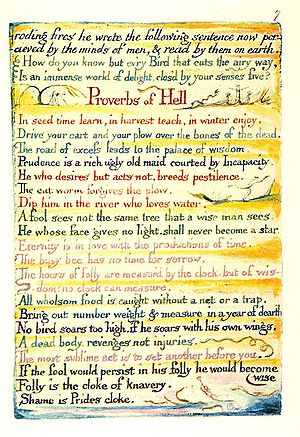
For the past few weeks, Cheryl Ball has been challenging me (and sometimes annoying me) with her insistence that those of us in digital pedagogy up our game. But, of course, I should remember my Blakean mantra from The Marriage of Heaven and Hell: “[o]pposition is true friendship.” She questioned my use of the word “article” to designate blog posts in my most recent digital pedagogy roundup. She suggested that academic blog posts needed a separate category than traditional peer-reviewed scholarship. She lamented the fact that many of these posts by digital humanities scholars amounted to nothing more than “this is what I did in class today,” rather than the kind of nuanced, careful research found in journals. Of course, scholars like Alex Reid and Eileen Joy are already theorizing what they call “middle state scholarship” while Mark Sample has identified blogging as a form of “serial scholarship,” and I do believe that such work has a place in academic discourse.
However, Cheryl’s editorial in Kairos yesterday continued the challenge, and sparked a few thoughts of my own:
But I don’t teach literature or creative writing and so on, so I need you to teach me how to teach them better. I want to learn from you, from literary-critical scholars who teach with technology, how you do it in your classrooms and how you teach others to teach with technology in a literary context. I can’t learn much from blog posts and Storifys and how-tos.
Cheryl draws a useful distinction here between the “big-tent” digital humanities that many of us try to clumsily draw around a huge field, and a question I feel is still being ignored by the scholars in literary studies who work in the digital humanities: what is it that literary studies, specifically, can bring to the study of teaching and technology?
It’s telling to me that the first version of the MLA Commons-sponsored Literary Studies in the Digital Age does not contain a single article on pedagogy. While the editors Kenneth Price and Ray Siemens mention in the introduction that digital methodologies are changing the way literary scholars gather data, the processes by which textual editing occurs, and the “self-fashioning” of DH training, there is little reflection on how these changes are effecting the classroom and what kinds of work are now possible because of them. Apart, for example, from simply playing around with Voyant, how does data-mining effect the day-to-day discussions that occur in literature classrooms? How might the fact that distant reading can give us a much larger corpus transform the way we construct syllabi? How are classes on textual editing, like this one from Jeffrey Schnapp and Dennis Tenen, changing how students think about the materiality of literature? To be fair to the editors of Literary Studies in the Digital Age, they envision the edition expanding over time, and I’m hoping that at some point pedagogy is included.
Even when literary scholars write pieces on digital pedagogy - Brian Croxall, Leeann Hunter, Katherine Harris, Diane Jakacki, Jentery Sayers, Kathi Inman Berens, Mark Sample, The Journal of Interactive Technology and Pedagogy, TECHStyle, and the Hybrid Pedagogy group are all great examples of pioneers in the digital pedagogy field - it is often difficult to identify what it is as literary scholars they bring to the table. Most pieces on digital pedagogy talk about methodology, while remaining largely silent on the content of literary education. Perhaps many English teachers involved in digital pedagogy do not consider themselves literary scholars. In a Facebook response to a conversation about the role of digital pedagogy in literary studies I had with several scholars on December 30, for example, Ted Underwood said:
This may sound like a flip answer, but at this point I’m honestly not even sure what discipline I’m in. Before I can think seriously about DH pedagogy, I have to figure out a) what I’m teaching and b) to whom. I mean that literally. It’s not clear to me that English majors are still the primary audience for the courses I would want to teach.
Ted’s confession is important. It’s not always easy to know just what we are doing with literature anymore. Yet, I hope that - in the rush to adopt the digital humanities and digital pedagogy - we do not abandon literary studies wholesale. I know that I embraced literary studies at an early age because it captivated me. I love reading novels and poems. I love talking about issues of race, gender, sexuality, class, and how history intersects with the lives of specific people reflecting on their world. I remember talking to one of my professors when I was an undergraduate unsure about whether I should go to graduate school in English or in Philosophy. Now, given the subsequent crises in both fields, the entire conversation might appear ludicrous to some people - but stay with me here. Peter Meidlinger, my professor, looked back at me and said, “Well, Roger, Philosophy is great, but Literature gives you the opportunity to connect to individual voices from the past in ways that few other disciplines allow.” And despite the fact that literary studies sometimes seems antiquated to me, despite the fact that I get annoyed with teachers who don’t think about what career options we can give our graduates, this part of literary studies - its ability to form a fragile and fine-grained thread from me to the past - is very compelling.
I believe that digital technology can make that thread stronger, not weaker. We can design classes that merge digital humanities methodologies with the content of survey courses in ways that deepen our students’s ability to connect with writers of the past. We can enrich the study of technology and teaching with specific, research-oriented work that gives a literary perspective on debates already occurring in fields like Communication and Computers and Composition. We do need to up our game. But we need to do it in ways that benefit the values we hold as a discipline, even while we carry those values into new modalities.
Aside: I realize that this is a blog post and not a peer-reviewed article. But I thought this kind of venue could serve as a useful starting point for further reflections on the relationships between digital literary studies and pedagogy.
**Update: Ted Underwood directed me to Brett Hirsch’s Digital Humanities Pedagogy: Practices, Principles and Politics. The essay by Matthew K. Gold on his “Looking for Whitman” project is probably the closest to the kind of pedagogy I’m envisioning here. In it, Gold connects Whitman’s sense of place in Leaves of Grass with a networked classroom environment where students on different campuses “trace the lingering imprints of Whitman’s footsteps in the local soil” (153). As Mark Sample, Paul Benzon, Brian Croxall, and Erin Templeton found with their networked reading of Mark Danielewski’s House of Leaves, combining networked teaching environments with different localities can create a powerful interface between digital pedagogy and literary studies. As Gold mentions in the essay, his Whitman project “worked within discrete institutional settings to create a shared online learning experience that bridged institutional divides” (165). Other disciplines like composition and history can experiment with locality, but the emphasis on community within literary studies - especially with poets and authors who are interested in place - makes it ideal for the kinds of pedagogical experiments being undertaken by these projects. Locality is also important in Hugh Crawford’s Thoreau project, where he combines the “making” and collaborative building spirit of the digital humanities with older forms of carpentry by having students use Thoreau’s Walden to construct a replica of his house. Again, many of these projects fall into Ball’s “look what I did in class” criticism, and do not always fully draw out the theoretical implications of their experiments.
 CFP: “Digital Humanities: Literary Studies and Information Science”
 CFP: Evaluation and Assessment of Digital Humanities Scholarship
 Comics as Scholarship: Digital Humanities Quarterly Special Issue