
This is part of a longer book project I coauthored with Jason Whittaker called William Blake and the Digital Humanities: Collaboration, Participation, and Social Media. I wanted to look at Blake as a test case for understanding how digital modalities can impact what literary studies means to us. In other words, I wanted to think about the digital humanities as more than a set of practices, but as something that changes how we understand literary reading and literary reception — in other words, literary studies.
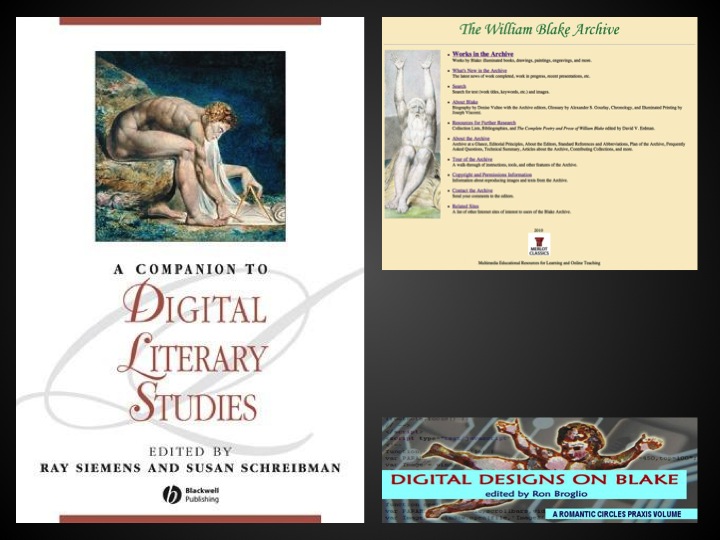
Blake’s already had a long history with the digital humanities. His monotype (basically a drawing on copper) titled Newton appears on the cover of Ray Siemens and Susan Schreibman’s A Companion to Digital Literary Studies. He’s also been the subject of several digital archives: from the practically inaccessible hypercard Blake Multimedia Project to Nelson Hilton’s Blake Digital Text Project, and finally the much celebrated William Blake Archive. Ron Broglio even edited a collection of essays discussing Blake’s connection to gaming called “Digital Designs on Blake.” However valuable these projects, many of them suffer from what Marcel O’Gorman calls the “archive fever” of the digital humanities. According to O’Gorman, digital humanities scholars only use a portion of the potential of digital media — specifically that which appeases “their nostalgia for print culture and [...] the demands of a digital-oriented, techno-beurocratic culture that values predictable techno-scientific methods (e.g. archiving) over interpretation, and most of all, invention” (11).
A critique of the bureaucracy of the digital humanities doesn’t really interest me here, except to say that (via Cathy Davidson) we should be using digital technology to undermine the industrial culture that values predictable methods and invest in the creativity that will help our students in an increasingly unpredictable world. On the other hand, there is a large amount of activity online that simply isn’t noticed by digital literary archives at all - one that engages in communication, creativity, and collaboration through social media channels. What would it be like to start noticing this data and — especially when such production is connected to literary studies — promoting it as an essential part of our discipline?
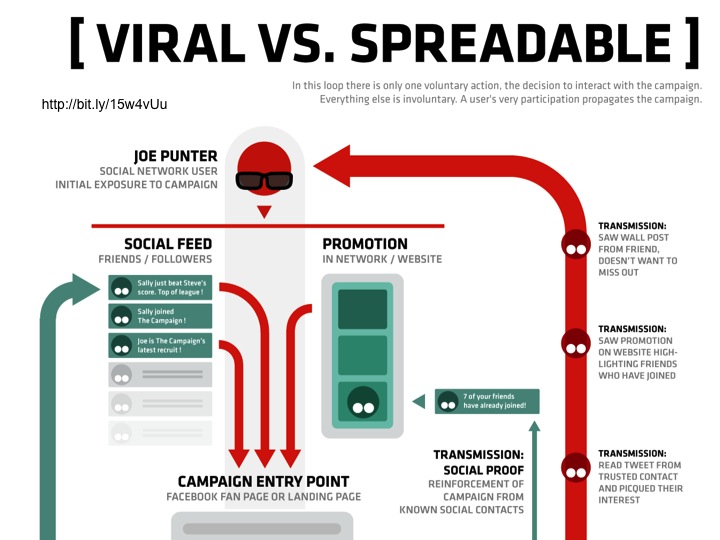
Combining forms of literary reception with, for example, the work done by Henry Jenkins, Sam Ford, and Joshua Green on Spreadable Media may give us a sense of how literary studies is (in my view) being reinvented through social media. In this model, as the authors argue, “material is shared by virtue of its adaptability to different conditions and its ability to be adjusted to fulfill a wide range of needs and motivations” (86). The archive model uses digital technology to do what scholars have been doing for decades: conceive of knowledge as housed in spaces, and the method is to draw audiences to those spaces. Instead, I want to suggest that Blake’s work is remarkably sharable, that is - his work can be adapted to fit a range of needs and motivations.
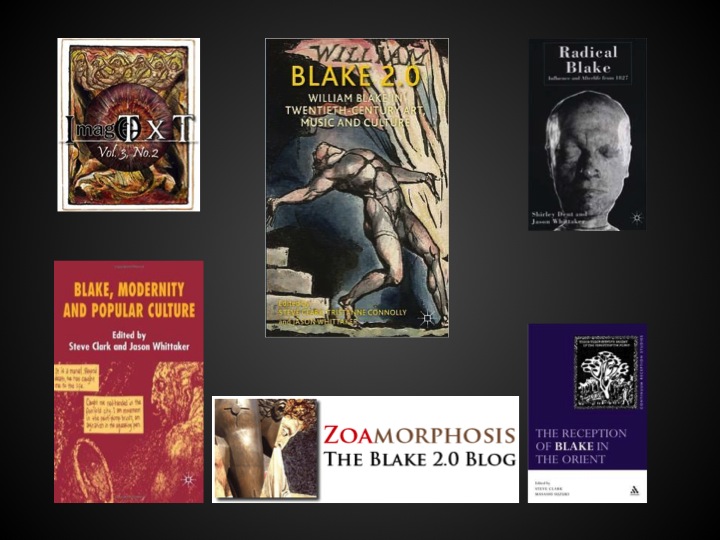
My work on Blake, the digital humanities and social media emerges from a field that has - itself become more central in British Romanticism over the past ten years. Reception studies of Blake began decades ago in 1970, with the publication of Joseph Wittreich’s book Nineteenth Century Accounts of William Blake, a book that traced Blake’s growing popularity in the Victorian period due to the efforts of Alexander Gilchrist, Algernon Swinburne, and the Pre-Raphaelites to name a few. Since then, numerous books have looked at different aspects of twentieth century reception: from the Japanese reception of Blake in Clark and Suzuki’s The Reception of Blake in the Orient to Blake in comics (my and Donald Ault’s William Blake and Visual Culture), poetic interpretations of Blake (Clark and Whittaker’s Blake, Modernity, and Popular Culture), and modernist novels inspired by Blake (Dent and Whittaker’s Radical Blake and Edward Larrissey’s William Blake and Modern Literature). I am also in the process of revamping a website that traces Blake’s reception with Jason Whittaker called Zoamorphosis: The Blake 2.o Blog.
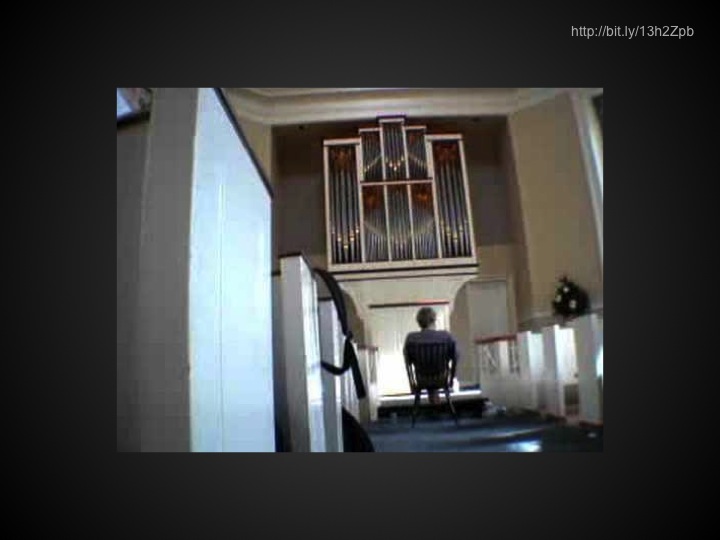
Like many of the adaptations and appropriations of Blake’s work, online artifacts often take an oppositional stance toward the subject matter. We argue in William Blake and the Digital Humanities that this is appropriately Blaken since Blake, also, adapted work from the past in what he called an infernal or diabolical manner (i.e. the Bible, Michelangelo, John Milton). Consider this short video with noted Blake scholar Athelred Eldridge, where students joke about Eldridge’s performance of Blake’s poem Milton. None of the students care about Blake, and yet it becomes a medium that nevertheless transmits Blake’s work. Those who appropriate Blake’s work online might do so without having much knowledge of Blake, or they may do so without even intending to do anything with Blake at all.
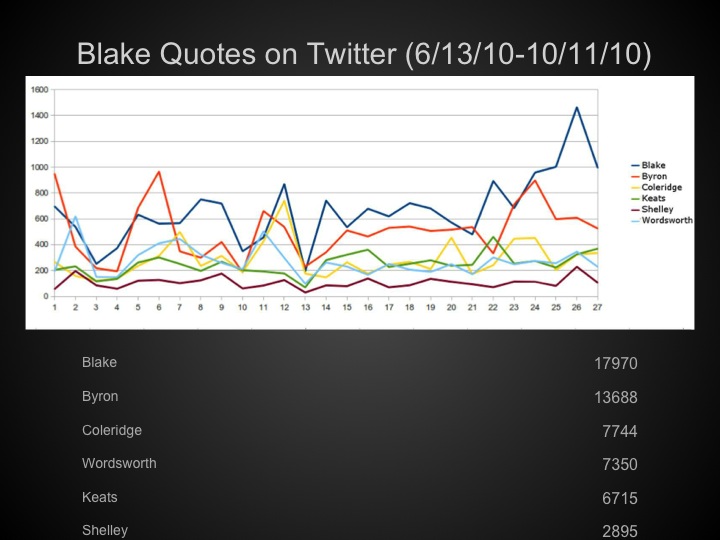
One way we can study Blake’s influence online is through a simple distant reading exercise. Here is a 6 month study, undertaken in 2010, of Twitter quotations by the “big 6″ Romantic poets. As an aside, there are obvious limitations to the way this study was performed. For example, all of the surveyed poets are men, and it was difficult (if not impossible) to compare the Romantic poets to Shakespeare (who generated about 6 times the number of quotations) or the Bible (about 20 times). More generally, though, we wish to show how this type of study illustrates how a social media apparatus like Twitter generates Blakean noise that can be visualized. Some other limitations: We’ll see how what counts as a “Blake quotation” can often include misappropriations and misquotations. Second, about 19% of Byron’s quotations are retweets of the phrase “Always laugh if you can, it is cheap medicine,” and (perhaps not surprisingly) he is the most popular of the six to be quoted in a different language.
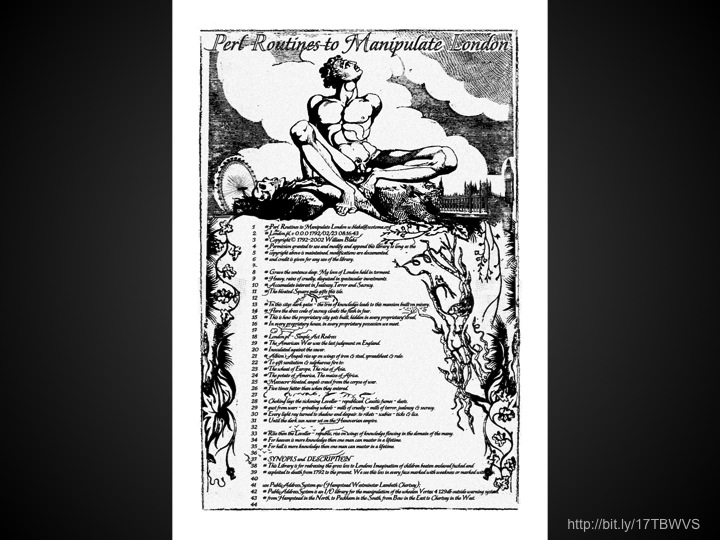
Here’s a Pearl version 0f Blake’s poem “London,” created by Graham Harwood. It doesn’t work, since the modules referred to in the program don’t exist. But if it did, it would calculate the gross lung capacity of all children living from 1792 to the present as they screamed at the top of their lungs — signifying their suffering. The implicit argument of Harwood’s piece is that the program adds a calculative dimension to representative poetry that has the potential to enact what is often merely referred to.

One of my students from Georgia Tech, Charles Hancock, created a series of Blakean memes after I off-handedly compared his artistic method to the circulation of memes in digital culture. Hancock took issue with my comparison of the meme to what Blake accomplished, saying that memes could be considered “a bit shallow.” Nevertheless, he accomplished a powerful critique of Blake’s persona along with that of his poetic characters by imagining them in various different cultural roles.

Blake has also been seen as a historical “patron-saint” of the DIY maker movement. Not only did he want his readers to free themselves with his poetry, he took responsibility to publish and craft his work himself. If we agree with Jenkins, Ford, and Green that the future of media (and I’d argue literary studies) centers around spreadablity, then one task for a digital literary studies is to track how creativity appropriates our literary past throughout culture. Another would be to advocate for the open and free exchange of ideas, through the Creative Commons movement or the Open Access movement. Cultural memes are being used to create new social experiences online, and while those experiences have their own political challenges, larger concerns for literary studies include challenging companies to have greater transparency and to allow for universal participation in the cultural experiences that will shape the next century. As Blake said in a 1799 letter to Reverend Trussler “Tho’ I call them Mine I know they are not Mine.”
-
James Rovira
-
http://www.rogerwhitson.net/ Roger Whitson
-