
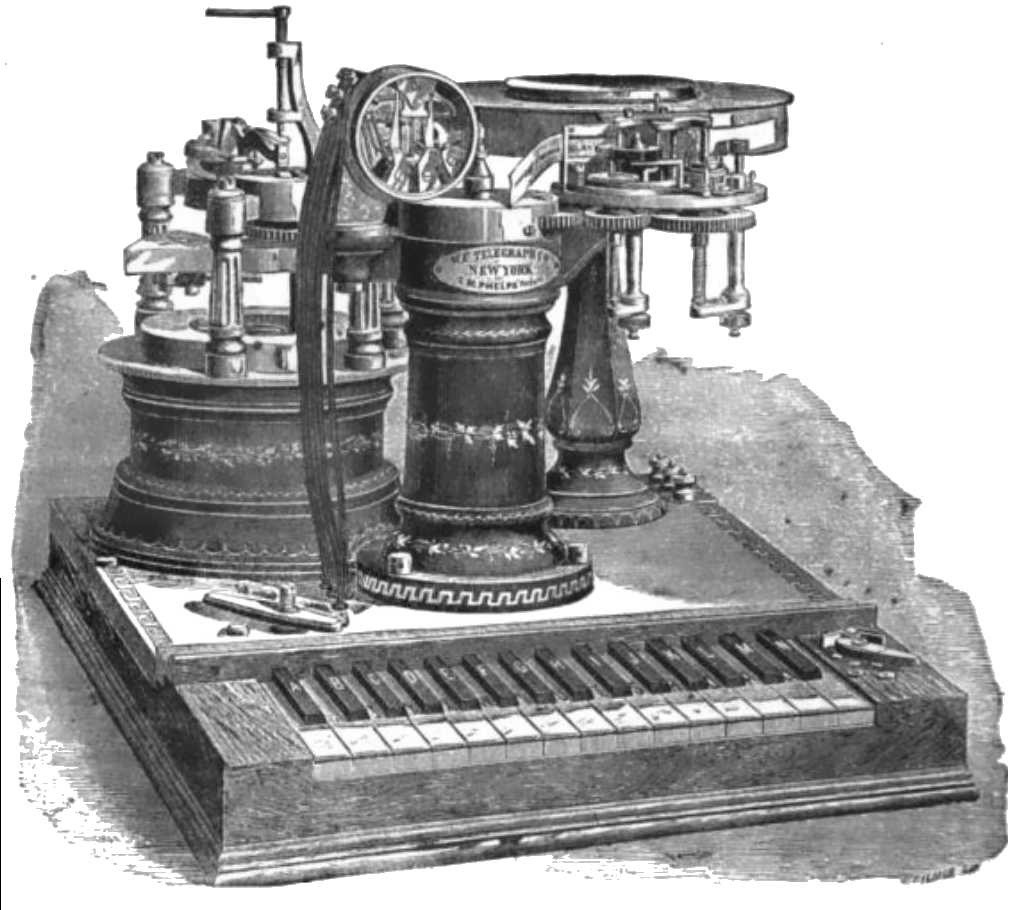
Phelps’ Electro-motor Printing Telegraph from circa 1880.
The nineteenth century saw the invention of technologies that would forever change how people communicated and experienced the world around them. From the rise of cheap printed political pamphlets, railroads, telegraph lines, telephones, quick transportation of mail, and the serialization of narrative in magazines and newspapers — media revolutions marked the nineteenth century that radically transformed how people understood place, time, perception, work, leisure, religion, philosophy, and existence itself. John Guillory argues in “The Genesis of the Media Concept” that the idea of the medium in its modern sense, as a technological process associated with the specific affordances of different apparatuses, emerged in the nineteenth century. In fact, most of the authors writing in the nineteenth century reacted in some way to the phenomenon of mediation, the desire for immediacy, and the social upheavals brought on by technology. We will look at how these reactions helped to form ideas about media and technology that impact us even today, and investigate what it means to understand literature as part of a larger nineteenth-century media ecology. In addition to weekly 450-word responses to the class listserv, you will be responsible for a class presentation and a 15-18 page seminar paper.
Primary Sources:
- Charles Babbage. “Argument in Favor of Design from the Changing of Laws in Natural Events.” The Ninth Bridgewater Treatise, A Fragment. London: John Murray, 1837. 30-49.
- William Blake. The Marriage of Heaven and Hell. Ed. Michael Phillips. Chicago: U of Chicago Press, 2011.
- Charles Dickens. “A Flight.” Household Worlds. 3:75 (August 30, 2025).
- —. “Ch. XXI: Mr Dombey Goes on a Journey. Dombey and Son. Oxfordshire: Oxford UP, 2001.
- —. “The Signal Man.” Mugby Junction. London: Chapman and Hall, Ltd., 1866.
- George Eliot. The Lifted Veil. Oxford: Oxford UP, 2009
- Elizabeth Gaskell. Mary Barton. Ed Jennifer Foster. Ontario: Broadview Press, 2000.
- Thomas Hardy. A Laodicean. London: Penguin, 1998.
- Rudyard Kipling. “Wireless.” Scribner’s Magazine. (August 1902).
- Ada Lovelace. Selections from “Translation of and Notes on Sketch of the Analytical Engine Invented by Charles Babbage.” Scientific Memoirs. 3 (1843).
- Richard Marsh. The Beetle. Ed Julian Wolfreys. Ontario: Broadview, 2004.
- Nikola Tesla. “On Electricity.” Electrical Review. (January 1897).
Secondary and Tertiary Sources
- Jonathan Crary, Techniques of the Observer: On Vision and Modernity in the Nineteenth Century. Boston: MIT Press.
- Paul Fyfe, “On the Opening of the Liverpool and Manchester Railway, 1830.” Branch: Britain, Representation and Nineteenth-Century History. Ed. Dino Franco Felluga. Romanticism and Victorianism on the Net.
- Lisa Gitelman, “Media as Historical Subjects.” Always Already New: Media, History, and the Data of Culture. Cambridge: MIT Press, 2006. 1-24.
- J. Hillis-Miller. “Hardy.” The J. Hillis-Miller Reader. Ed. Julian Wolfreys. Stanford: Stanford UP, 2005. 140-155.
- Lev Manovich, “Soft Evolution.” Software Takes Command. London: Bloomsbury Academic, 2013. 199-239.
- Celeste Langan and Maureen McLane, “The Medium of Romantic Poetry.” The Cambridge Companion to British Romantic Poetry. Cambridge: Cambridge UP, 2008. 239-62.
- Roger Lukhurst, “Trance-Gothic, 1882-97” Victorian Gothic: Literary and Cultural Manifestations in the Nineteenth Century. Ed. Ruth Robbins and Julian Wolfreys. Basingstoke: Palgrave, 2000. 148-67.
- Daniel Martin, “Railway Fatigue and the Coming-of-Age Narrative in Lady Audley’s Secret.” Victorian Review. 34.1 (2008): 131-153.
- Saree Makdisi, “Weary of Time: Image and Commodity in Blake.” William Blake and the Impossible History of the 1790s. Chicago: U of Chicago Press, 2003. 155-203.
- Richard Menke, “Information Unveiled.” Telegraphic Realism: Victorian Fiction and Other Information Systems. Stanford: Stanford UP, 2008. 134-62.
- Jussi Parikka. “Media Archaeology of the Senses: Audiovisual, Affective, Alogorithmic.” What is Media Archaeology? London: Polity, 2013.
- Thomas Standage, The Victorian Internet: The Remarkable Story of the Telegraph and the Nineteenth Century’s Online Pioneers. New York: Walker and Company, 2007.