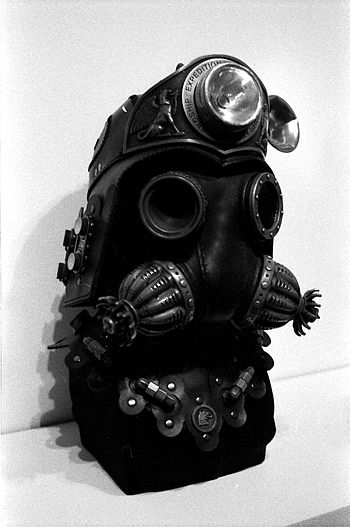
From the Steampunk exhibition at the Oxford Museum of Science. Flickr data (on upload date): Tags: steampunk, mask, delta3200 License: CC BY 2.0 (Photo credit: Wikipedia)
Steampunk is often described as “Victorian science fiction,” but its relationship with the Victorian period is complicated by the many settings where steampunk novels occur and the many modalities fans use to engage with the genre. Steampunk novels take place outside of England (Jay Noel’s Dragonfly Warrior and the forthcoming Steampunk World) and in weird fantasy realities (China Mieville’s Perdido Street Station and KJ Bishop’s The Etched City). There are steampunk video games (Bioshock Infinite), vehicles (The Neverwas Haul), and gadgets (Tim Sheely’s Teacup Stirling Engine). Steampunk fans meet at conventions and go to steampunk concerts. There are even chefs who self-identify as steampunk, and see their craft as mixing flavors from the Victorian diet with the gastronomic needs of today.
The sheer diversity of narratives currently emerging from steampunk requires rethinking its relationship to other Neo-Victorian texts which, in the words of Louisa Hadley are forms of “historical fiction” that have both a “Victorian and postmodern context” (5). It is no longer appropriate to reduce steampunk as a cultural phenomenon to Victorian history or literary expression. As an alternative, I’d like to propose interpreting steampunk through the lens of design fiction. Joshua Tanenbaum, Karen Tanenbaum, and Ron Wakkary have previously aligned steampunk with design fiction by examining how its “speculative imaginings and […] material practices are inextricably linked to each other,” and by suggesting that appropriation or “the use of a designed artifact for a purpose different than intended by the designer(s)” is central to the practice (1583-4). I suggest that the definition of steampunk as a design fiction is different than how most scholars conceptualize the Victorian as a historical period, and yet it is also useful in interpreting the creative output of non-literary steampunk. Steampunk customizes the Victorian to enable a wider variety of participants to complicate its ideas, technologies, fashions, and ideologies.
This presentation will look at steampunk design and media art in order to examine how it preserves Victorian culture. I suggest that the customization or modding of steampunk design is a cultural response to contemporary concerns regarding digitization and historical preservation. As Bethany Nowviskie has argued, “we need to develop digitization standards with an eye [toward] the continual migration of digital and digitized works to new discovery and delivery platforms and interfaces.” I show how modding in steampunk design is a form of rethinking our interface with Victorian literature. What does it mean that consulting companies can turn to Victorian technological tropes like switches to develop a cell-phone in India for non-literate users who do not understand Western forms of skeumorphic design? I argue that such practices are essential to understanding Steampunk and Victorian culture as practices extending beyond literary interpretation.
Works Cited
Bethany, Nowviskie. “Reality Bytes.” Web log post. Nowviskie.org. 20 June 2012. Web. 7 Mar. 2014.
Hadley, Louisa. Neo-Victorian Fiction and Historical Narrative: The Victorians and Us. Houndmills, Basingstoke, Hampshire: Palgrave Macmillan, 2010.
Print.
Joshua, Tanenbaum, Tanen Karen, and Wakkary Ron. “Steampunk as Design Fiction.” CHI ’12 Proceedings of the SIGCHI Conference on Human
Factors in Computing Systems.: 1583-592. Web.
