Hi, so I decided to give a bit of a theoretical background for my own approach to alternate histories of the digital humanities by looking at a specific genre that theorizes alternate history quite well: steampunk.
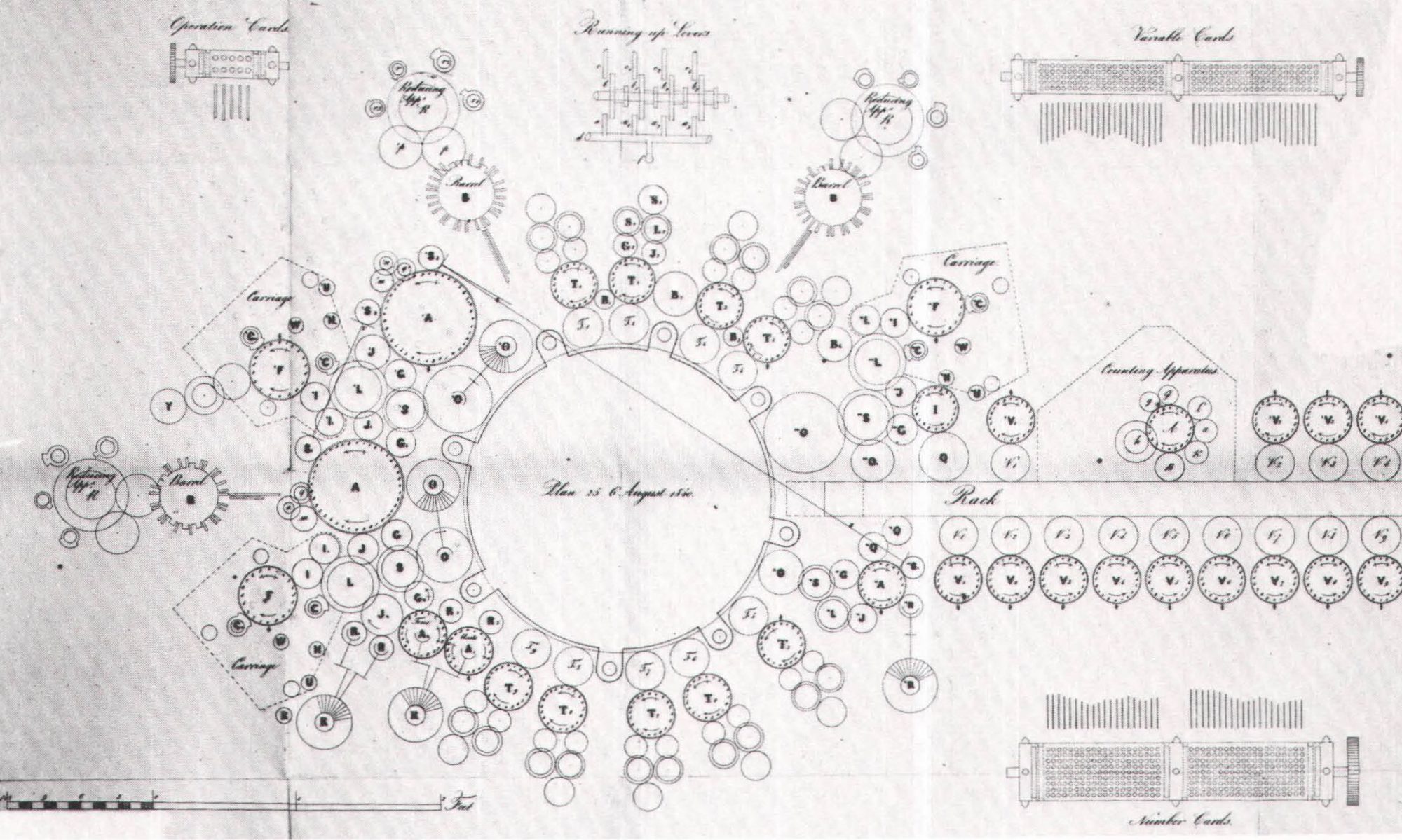
Steampunk explores how technology might have developed differently given a different set of historical circumstances. One of the more famous examples of steampunk alternate history is William Gibson and Bruce Sterling’s The Difference Engine, in which nineteenth-century industrialist Charles Babbage actually creates the analytical engine in the 19th century, leading to an information age that occurs one century early.
These types of explorations are important for media archaeology, the field that — as Lori Emerson explains — eschews the standard model of “reveal[ing] the present as an inevitable consequence of the past” but sees our present as “one possibility generated out of a heterogeneous past.” Jussi Parikka, in fact, begins What is Media Archaeology? with an extended consideration of steampunk as an exemplary media archaeological practice, arguing that it falls outside of mainstream digital methodologies and is what Deleuze and Guattari call a “nomadic, minor science”: a set of quirky hacker techniques whose innovations are appropriated by the more economic powers of the state (qtd. in Parikka 168). As with any manifestation of what Deleuze and Guattari call “royal science,” or a hegemonic system relying upon the appropriation of nomadic practices, steampunk creates a tension between such minor sciences and their corporate and academic use.
Instead of “big tents” or grant-funded infrastructural projects, steampunk emphasizes the small, the local, and the hobbyist. More generally, though steampunk’s localities are sites of intervention into the culture of computing: whether this means contesting the obsession of the consumer electronics industry with the ‘new’ or whether it means contesting the larger historical narratives about colonialism, heteronormativity, and sexism with different ways that history could have been. And, I should point out that this second phenomenon isn’t always aligned with progressive politics: there are fascist elements within steampunk that identify with the imperialism and white nationalism found in much of Victoriana. So, while my work on steampunk came out before Kelly-anne Connolly used the term “alternate facts,” it certainly recognizes that fascism is part of steampunk. Overall, though, steampunk foregrounds alternate history as a material struggle over the meaning of the past and how technology figures into it.
[Slide 5] I want to give two quick examples of the critique of temporal progressivism and historical homogeneity that I find in steampunk. The first is a set of hobbyist projects focused on rebuilding Charles Babbage’s difference engine. Babbage was the nineteenth century mathematician and industrialist who created the difference engine in order to automate the production of astronomical charts for commercial ships circulating goods to and from Britain. He also worked upon a second machine, called the analytical engine, with Ada Lovelace – the first person to theorize the notion of general computing: or the idea that numerical control could be extended to almost any kind of computational function.
Tim Robinson’s 2007 rebuilt Babbage’s Difference Engine No. 1 using parts manufactured by the toy company Meccano. Robinson says that he was intrigued by the brand’s claim to “do something real,” and the tactile quality of Meccano parts mediates this sense of reality: the cold metal, the round rivets, the clicking of metal rods as they are moved by other parts. The machine calculates numbers up to four digits and three orders of difference. It is composed of several ratchet wheels, each with 20 teeth and which are covered by printed tape showing numbers from 0 to 9. While visiting Robinson’s website, you can find descriptions of his nostalgia for the toy company, which he describes as helping him build “the machines of my youth” — including “astronomical clocks, orreries, looms and other textile machinery […] and perhaps most enduring, the differential analyzer (and analog computer).”
[Slide 6] Robinson’s hobbyism recalls Matt Kirschenbaum’s definition of retrocomputing in the digital humanities in which “computers afford diverse forms of interaction” and that such particularity can open up new opportunities for understanding the scope of DH, including “the unapologetically small, the uncompromisingly local and particular: this machine, that pin, that screw (the one you scraped your knuckle getting loose), that board (the one you burned yourself soldering)” (196). Steampunk hobbyists can encourage this kind of local diversity and particularity in the digital humanities by celebrating the various relationships machinists create with their technologies in the act of making them. These moments of clarity, struggle, and material tactility are all too often obscured by progressive senses of technology, in which the concern is ever more efficient processes.
[Slide 7] The other side of this locality in steampunk involves what’s been described as “multicultural steampunk.” While “multicultural” is often the most used adjective ascribed to this group of steampunk fans, a prominent figure in the movement Diana Pho has admitted that it “can fall prey to uncritical interpretations,” the worst being that diversity is “merely additive […] instead of actively de-centering whiteness.” Even so, multicultural steampunk also engages in what Jayme Goh calls “tamper[ing] with timelines [in order to] tinker with how migration, assimilation, segregation, and other such cultural movements occur; this makes visible how identities are shaped by such histories, and how they could be shaped otherwise” (14).
“Imperial Steam and Light” artist James NG (“Ing”), uses alternate history to imagine how technology would have developed differently given a separate set of historical circumstances. In an interview with the Brazilian web series Steamcast, Ng says that his work searches for alternate models of modernization apart from those reflecting European ideals. “Basically,” Ng argues, “if a country wants to be a global international city, it has to model itself after a Western city like New York or Paris.” His images are patterned after a world where “China was the first to become modern. And now the rest of the world would have to copy China.”
[Slide 8] I’d like to end my talk with a consideration of the theme of the panel, and by way of calling into question its (and my) invocation of alternate history. The distinction Deleuze and Guattari make between royal science and nomadic science, in some ways, belongs to a different time — in which the most important political struggles took place between the emergent global powers of neoliberalism and all of the various the nomads neoliberalism was always fated to betray. In many ways that danger is more acute after the rise of the alt-right — but it seems that the struggle is different. I’m reminded of a post Pho wrote in light of the disastrous U.S. election. Pho calls the world “a darker one” in which steampunks “playacting as fascists comes too close to the swastikas and hate speech I see graffitied on the streets of the city I love.”
Fascist cosplay occurs most prominently in dieselpunk, which features science fiction fantasies happening in World War II, but Pho’s argument applies equally to the uncritical celebration of locality in the digital humanities — particularly an era of alternate histories and alternate facts. The construction of “big-tent digital humanities” too easily reproduces the problems of neoliberalism: a sense of diversity as merely accretive, a (sometimes willed) ignorance of anything that doesn’t fit under the tent, racisms and labor exploitation made invisible. Yet, as we’ll see, in addition to the notion of locality, a theory of alternate histories within the digital humanities must also incorporate what Roopsi Risam has identified as an intersectional sensibility. Locality, alternate history, and multiplicity aren’t enough to produce the progressive changes many of us want to see in the digital humanities.